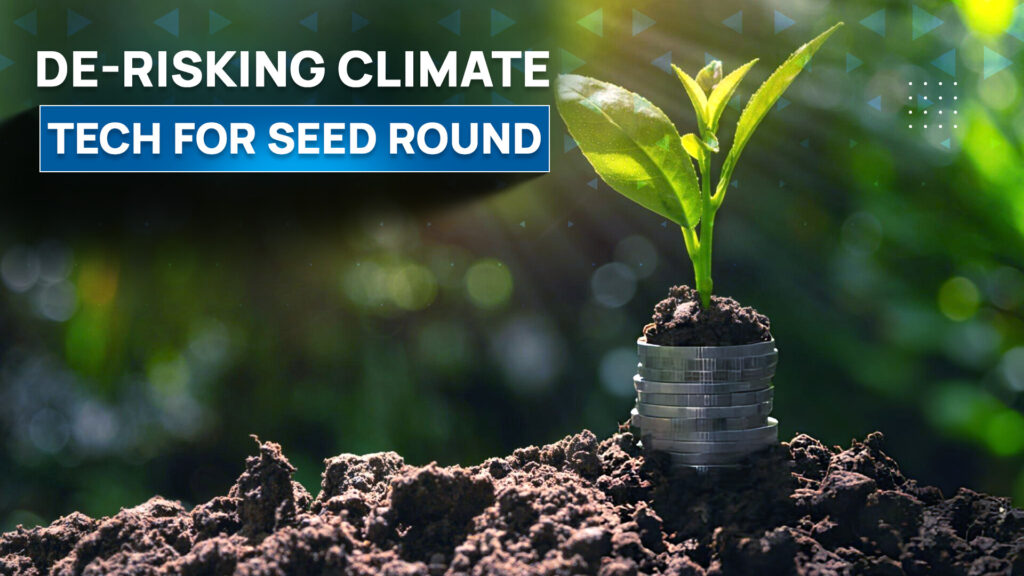
Raising a seed round as a climate startup is no longer about selling a big idea wrapped in a good mission. That era is over.
While climate tech still remains one of the largest opportunities of the next decade, seed investors are underwriting it with the same rigor they apply to any venture-scale business. Climate impact might open the conversation, but it does not lower the bar on fundamentals.
The hard truth is: climate does not excuse weak market sizing, unclear revenue models, unresolved technology risk, or policy-dependent economics. If anything, the uncertainty of impact-driven businesses makes investors more selective about where they place early bets.
This blog breaks down how seed investors actually evaluate climate startups today, what builds confidence, what introduces risk, and why some founders earn strong valuations while others struggle to get a round across the line.
Market Size Still Comes First, Green Initiative Doesn’t Change the Math
Seed investors still begin where they always have: market size. Climate impact does not reduce the need for venture-scale outcomes, nor does it justify narrow or artificially constructed markets. A climate tech business, like any other business, must be capable of scaling into a large, durable business on its own economic merit.
What earns a premium is not just a big TAM (Total Addressable Market) slide, but markets that exist independent of regulation, where customer demand is already visible and expanding. Investors look closely at whether current factors accelerate an existing market or attempt to create one from scratch.
Policy as a Tailwind, Not a Load-Bearing Wall
Policy matters in climate tech, but investors are careful about how it matters. The strongest seed-stage companies are viable businesses today, with policy acting as a catalyst rather than a prerequisite for survival.
When underwriting policy exposure, investors stress-test scenarios: incentives expiring, regulations shifting, and political priorities changing. They pay a premium when the business model remains intact across those scenarios, and policy simply shortens adoption cycles or improves unit economics.
Conversely, startups that depend on a single regulation, subsidy, or incentive program face valuation pressure. If policy is doing the heavy lifting, rather than amplifying a working model, it becomes a risk factor, not a value driver.
Technology Risk: De-Risked Enough for Seed
Climate tech often involves genuine technical complexity, but seed investors are not funding open-ended science. What they underwrite is how much technical risk remains, not how impressive the innovation sounds.
Premium valuations emerge when core feasibility has been demonstrated, even if scaling, manufacturing, or cost optimization is still underway. Investors want confidence that the remaining work is executional, not wishful thinking.
When the central question is still “will this work at all?”, you might as well bid goodbye to the green premium. Novelty attracts interest; de-risking attracts capital.
Revenue Models That Prove Willingness to Pay
At seed, revenue is less about magnitude and more about signal. Investors pay close attention to who the customer is, why they are paying, and whether climate value translates into economic value.
Climate startups earn higher valuations when customers are paying because the product saves money, generates revenue, reduces risk, or improves compliance. Early evidence of willingness to pay, even at a modest scale, significantly reduces go-to-market risk.
Models that defer monetization, rely heavily on intermediaries, or depend on future credit markets are underwritten conservatively. The green premium increases when climate strengthens pricing power, retention, or margins—not when it postpones them.
Impact Metrics That Scale With the Business
Impact is essential, only when it is measurable, auditable, and structurally linked to growth. Investors increasingly distinguish between operational impact and narrative impact.
What earns a premium is impact that scales automatically as the business scales: more customers, more revenue, more measurable climate benefit. Clear baselines, credible counterfactuals, and metrics that matter to customers or regulators all strengthen investor confidence.
Impact that sits outside the core business, tracked separately or framed loosely, adds little valuation leverage. If impact cannot be measured or verified, it cannot be priced.
Teams That Reduce Execution Risk in Hard Markets
Climate markets are complex, regulated, and often capital-intensive. As a result, team quality carries even more weight at seed.
Investors pay up for founders who understand both the climate problem and the operational realities of solving it. They value realism over optimism, and clarity over vision alone.
Founders who acknowledge challenges, articulate trade-offs, and demonstrate execution credibility reduce potential risk.
Bottom Line: Climate Advantage Must Earn Its Valuation
The new green premium is narrower, but stronger.
Founders who earn it don’t ask investors to choose between returns and responsibility. They show that climate alignment makes the business more resilient, more defensible, and more valuable over time.
At seed, impact opens the door. Fundamentals decide the price.