At every stage of growth, startups face a common challenge: finding and retaining the right people. While founders often focus on product development, fundraising, and market expansion, the companies that scale successfully understand that talent and culture are equally critical to long-term success.
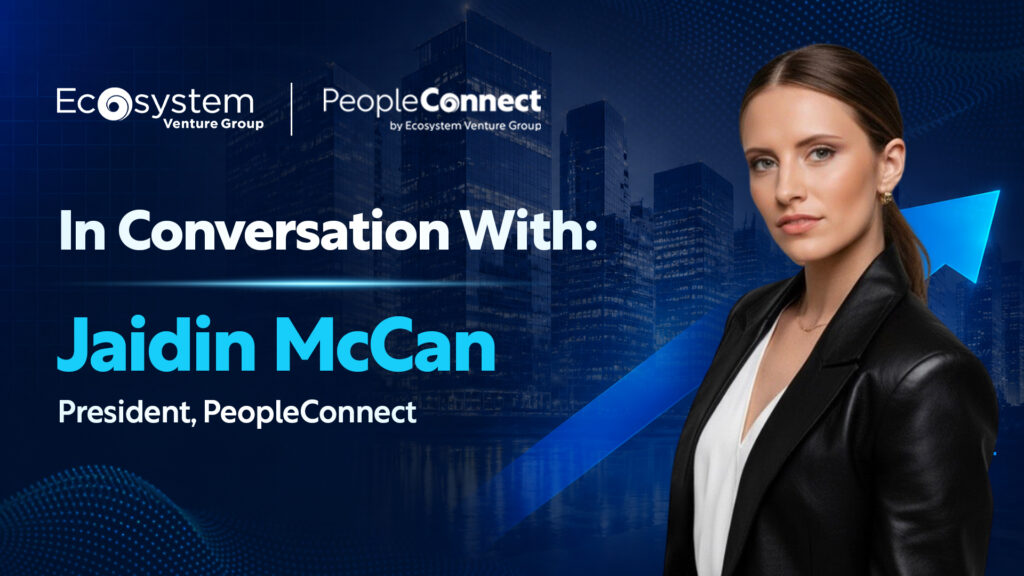
To explore the role that people play in building successful companies, we sat down with Jaidin McCann, President & Managing Partner of PeopleConnect and Venture Partner of EcoVG, for a conversation on talent strategy, leadership, company culture, and the hiring decisions that can define a startup’s future.
Q: Your passion lies in helping organizations scale through people and culture. What made you realize this was your calling?
A: Early in my career, I had the opportunity to build an entire HR department from the ground up for a startup hotel. I was responsible for everything—from recruiting and onboarding to payroll, benefits, and company policies.
That experience made me fall in love with recruiting because it allowed me to hear people’s stories and help build something meaningful through talent. Over time, I realized that people and culture are the engines behind high-performing companies.
When employees are engaged, supported, and inspired by strong leadership, they perform at a higher level. That’s why I believe HR isn’t simply a cost center—it’s an indirect profit center. Great people reduce turnover, improve productivity, and ultimately drive business growth.
Q: You’ve worked with venture-backed startups, Fortune 500 companies, and founders. How have these experiences shaped your view of talent?
A: The talent you need depends entirely on your stage of growth.
Startups need scrappy, adaptable people who can wear multiple hats and build alongside the founder. Enterprise organizations, on the other hand, require specialists with deep expertise in very specific areas.
What I’ve learned is that founders shouldn’t only hire for today’s needs. They need to ask themselves: Who can help us get where we want to be five years from now?
The people who help you reach product-market fit may not be the same people you need during rapid scaling or an IPO. Great hiring means balancing today’s priorities with tomorrow’s ambitions.
Q: Founders often prioritize fundraising and product development. When should they start thinking about hiring processes and culture?
A: From day one.
You may not need a full-time HR leader until you have around 100 employees, but you absolutely need to think about culture and hiring from the very beginning.
Culture gets built with or without intention. Processes form naturally, and if they’re not built correctly early on, they become much harder to fix later.
Founders should educate themselves on hiring, establish structured interview processes, and clearly define what they’re evaluating at each stage of the interview.
Too often, companies conduct multiple interviews that all ask the same questions and learn nothing new. Every interview should measure something different—skills, cultural fit, leadership potential, or trust.
Doing this correctly saves time, money, and the cost of bad hires.
Q: What do founders need from a talent partner beyond simply filling open roles?
A: They need an advisor.
Building a company involves far more than simply hiring someone to fill a position. Every hire impacts culture, performance, and ultimately the company’s future.
A strong talent partner provides market insights, compensation guidance, and strategic advice. They help founders understand when to hire, who to hire, and how to scale effectively. This advisory approach is central to how PeopleConnect works with founders—not as a transactional recruiter, but as a long-term partner invested in the company’s growth.
I remember working with a CEO who insisted on handling candidate offer negotiations himself despite having little experience in the process. After losing five candidates because he struggled to effectively communicate the company’s value and navigate negotiations, the board ultimately stepped in and changed the approach. The experience reinforced an important lesson: founders don’t just need someone to fill roles—they need partners who can equip them with the knowledge, tools, and guidance to become stronger leaders and hiring managers over time.
Most importantly, great talent partners help founders build the internal capabilities needed to scale successfully long after the hiring process is complete.
Q: What’s one leadership lesson that took years to truly understand?
A: Learning to teach instead of simply doing.
As leaders, especially founders, we often step in because we can solve problems quickly. But by constantly doing things for our teams, we prevent them from learning and developing.
Leaders need to invest time in training, coaching, and building systems that allow others to succeed independently.
The goal isn’t to become indispensable. The goal is to build a team so capable that the business can continue thriving even when you’re not there.
Many founders struggle with letting go because no one knows the business better than they do. But sustainable growth requires trust, delegation, and empowering others.
Q: If you could leave entrepreneurs with one piece of advice about building great companies through great people, what would it be?
A: Think strategically about three things:
- Build a thoughtful hiring process and know exactly what each interview is measuring.
- Hire for where your company needs to be five years from now, not just for today’s gaps.
- Be intentional about culture because it will form whether you shape it or not.
The most successful companies understand that people are their greatest competitive advantage. Great products matter, funding matters, and strategy matters—but ultimately, it’s great people who transform startups into enduring businesses.